


By William Childs Robinson
Bio
William Childs Robinson (1897–1982) was a true Southern Presbyterian pastor and theologian after the likes of James Henley Thornwell and B.M. Palmer. He was also a brilliant church historian, and one of the leading (and lone) conservative voices at Columbia Theological Seminary during its liberalization in the twentieth century. Born in Lincolnton, North Carolina, Robinson studied at Roanoke College and the University of South Carolina before receiving his B.D. from Columbia Theological Seminary, his Th.M. from Princeton Theological Seminary, and his Th.D. from Harvard University. In 1926, Robinson joined the faculty of Columbia Theological Seminary, where he would teach for more than forty years. He served principally as Professor of Ecclesiastical History, Church Polity, and Apologetics, retiring in 1967.
Robinson remained an ardent defender of historic, confessional Reformed orthodoxy and the rich theological heritage of the Southern Presbyterian Church. His writings addressed Christology, justification, Presbyterian history and polity, apologetics, and the manifold challenges posed by the toxic invasion of theological liberalism. His 1931 study, Columbia Theological Seminary and the Southern Presbyterian Church, remains an important historical account of that institution and its theological heritage. (You can find and read this work here: https://confessional.org/archives/20th-century/robinson-1931-columbia-theological-seminary-and-the-southern-presbyterian-church-1831-1931)
Robinson’s influence extended well beyond his own sermons, articles and books. He also discipled many young pastors who would later be instrumental in the formation of the Presbyterian Church in America (PCA) in 1973.
This article below comes from the introduction and opening pages of his book, The Certainties of the Gospel (1935). The other chapters of the book will be posted as a series in subsequent articles.
"Faith is a certainty," declared Patrick Hamilton, the man whose martyr flames lit the Reformation fires in Scotland. A glorious sense of certainty was characteristic of the Protestant of the Reformation. "God cannot be worshipped in doubt," cried Calvin and Cop as they publicly proclaimed the Protestant faith in France.
To the end of his life the Genevan insisted upon the necessity that we be assured of our salvation in order to invoke God as our Father in full liberty.[1] Indeed, certitude was so distinctive of the Protestantism of the sixteenth century that the Council of Trent made a vigorous thrust at "the empty confidence of the heretics." Following the tradition which began with Gregory the Great the Romanists left the veil of uncertainty hanging over the extent and the completeness of forgiveness. But the Protestants gloried in the certainty of sins forgiven.
When one compares much of current Protestantism with Romanism he finds the sixteenth century roles almost reversed. A thoughtful surgeon once asked the writer why the Roman Catholic went under the knife with so much more assurance than the Protestant. In neo-Protestantism faith is characteristically described as "a venture," "a betting one's life that there is a God," a decision made without adequate evidence by the naked power of an autonomous human will. Or if one turns to the neo-Calvinist,[2] [Karl] Barth's answer is too similar, at least in the feature of uncertainty. "Faith is a leap into the void," "the agitated persistence in negation" or, "a walking on a knife edge between yawning chasms."[3]
One of the writer's best students contrasted the neo-Protestant and the historic Protestant doctrine of faith in a sermon entitled, "The Faith of a Gambler, or the Faith of a Saint?"
A progressive transference of the Gospel emphasis from God to man has brought about this loss of certitude. Man is ephemeral, transient, variable, relative, uncertain, multitudinous. God is one, eternal, true, changeless, certain. The lost chord in modern Protestantism can be restored only by a new recognition of God's true relationship to the Gospel and the Gospel way of salvation. The pressure of opposition and persecution helped drive the Reformers back upon God.
There must be a return to God before there can be a return of certainty. Divine attestation must replace human autonomy. Instead of a progressive glorification of man there must come a progressive, or a cataclysmic, return to the Reformed slogan, soli Deo gloria.
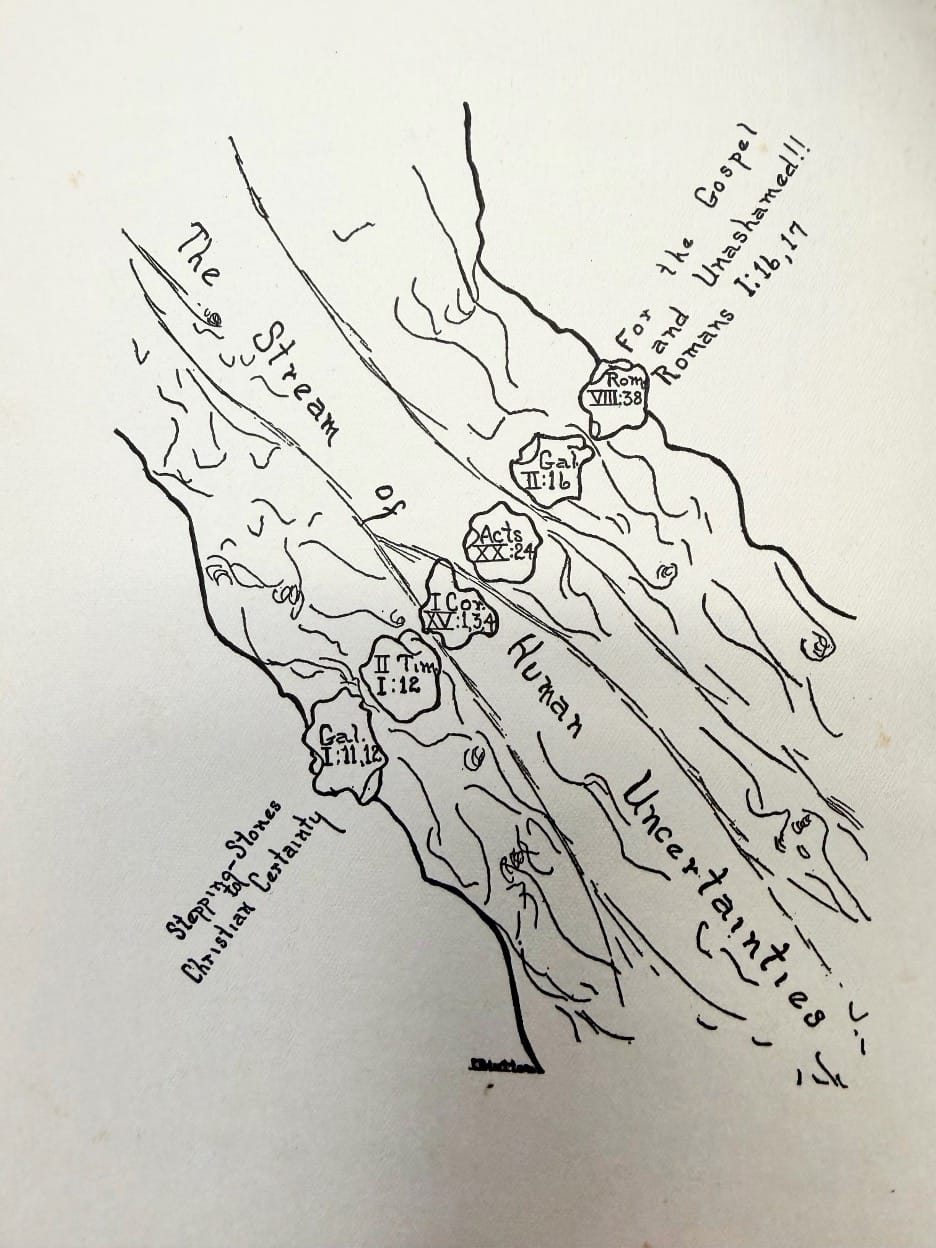
The Apostle has placed a series of stepping stones to the goal of this lost certainty. At each of the focal points in the Gospel Paul has erected not an "I think," not an "I hope," not an "I wager"; but an "I KNOW." These certifications present God with His certainty as the key to the present need. "The apostolic apologia is to lead to βεβαίωσις (confirmation) the direct certitude of the gospel."[4]
Paul's stepping stones mark the way Protestantism must travel if she is to recover her lost sense of certainty.
Paul's Path to Christian Certainty
"I make known to you, brethren, as touching the gospel which was preached by me that it is not after man... but it came to me through revelation of Jesus Christ." — Gal. 1:11-12 (R. V.).
"I know whom I have believed." - 2 Tim. 1:12.
"Now I make known unto you brethren the Gospel…that Christ died for our sins according to the Scriptures; and that he was buried; and that he hath been raised on the third day according to the Scriptures." - 1 Cor. 15:1, 3, 4. (R. V.)
"The ministry which I have received of the Lord Jesus to testify (attest) the gospel of the grace of God." - Acts 20:24.
"Knowing that a man is not justified by the works of the law, but by the faith of Jesus Christ." - Gal. 1:16.
"For I have been made certain, that neither death, nor life, nor angels, nor principalities, nor things present, nor things to come, nor powers, nor height, nor depth, nor any other creation shall be able to separate us from the love of God which is in Christ Jesus our Lord." - Rom. 8:38, 39.
The Quest for Certainty
The quest for certainty is the call of the hour. Haunted by fear men are yearning for a word that cannot be questioned. Business is ruthless in its demands and, apart from an unshakeable stay, crushing in its failures. The political map is kaleidoscopic in its changes; its leaders changeable and changing. In the hurdy-gurdy of today, eager student spirits are searching for the steel girders which alone can support the structure of life. And at least some of the more advanced scientists and philosophers are beginning to catch the glint of the Eternal as the implicate of the temporal. The modern realization that "time does not carry its meaning in itself" sends one back to the ancient doctrine that man has Eternity in his heart. Where can the man of today gain the assurance which breathed in the poet of yesterday?
"For though from out our bourne of Time and Place
The flood may bear me far,
I hope to see my Pilot face to face
When I have crost the bar."
Descartes tried to reach a foundation for certainty in the consciousness of the doubter. But perhaps a doubting consciousness is a poor basis for certainty. And the effort to make the truth of God and of external reality rest solely on one's ego is like trying to balance a pyramid on its apex. Small wonder, then, that modern philosophy capitulated to the skepticism of Hume and the uncertainties of Dewey's pragmatism. The ancients[5] could have told us that when man is the measure of all things, then all things flow, and lo, whirl is king. The only city that hath foundations is the city whose builder and maker is God. God is the only fulcrum on which the lever of certainty can rest. Only God can supply the eternal verities with which to erect the house of knowledge, to establish the city of abiding values, and to satisfy l'appe tit de monde meilleur (trans. "the hunger/longing for a better world").
[1] John Calvin, Institutes of the Christian Religion, 3.20.12, trans. Henry Beveridge (Edinburgh: Calvin Translation Society, 1846), 572.
[2] Ed. Robinson seems to be using this term “neo-Calvinist” to refer not to the school of Dutch Reformers such as Abraham Kuyper, Herman Bavinck, or Klaas Schilder, but rather, to what we would today call “neo-orthodox”, or what Robinson will go on to call “neo-Protestant”, in reference to Karl Barth. For a helpful article from W.C. Robinson on Karl Barth's theology, see: https://confessional.org/archives/20th-century/robinson-1928-the-theology-of-karl-barth-a-protest-and-a-standpoint See also his interview with Barth: https://confessional.org/archives/20th-century/robinson-1938-an-interview-with-professor-karl-barth
[3] In this case as in the doctrines of inspiration, history, reason and common grace the noted neo-Calvinist* fails to represent the genuine Reformed tradition.
[4] Andrew Duff Heffern, Apology and Polemic in the New Testament: The Bohlen Lectures, 1915, ed. James Alan Montgomery (New York: Macmillan, 1922), 77–78.
[5] Plato, Cratylus.


